
Compact 系统:3 种压缩机制
〇、引言
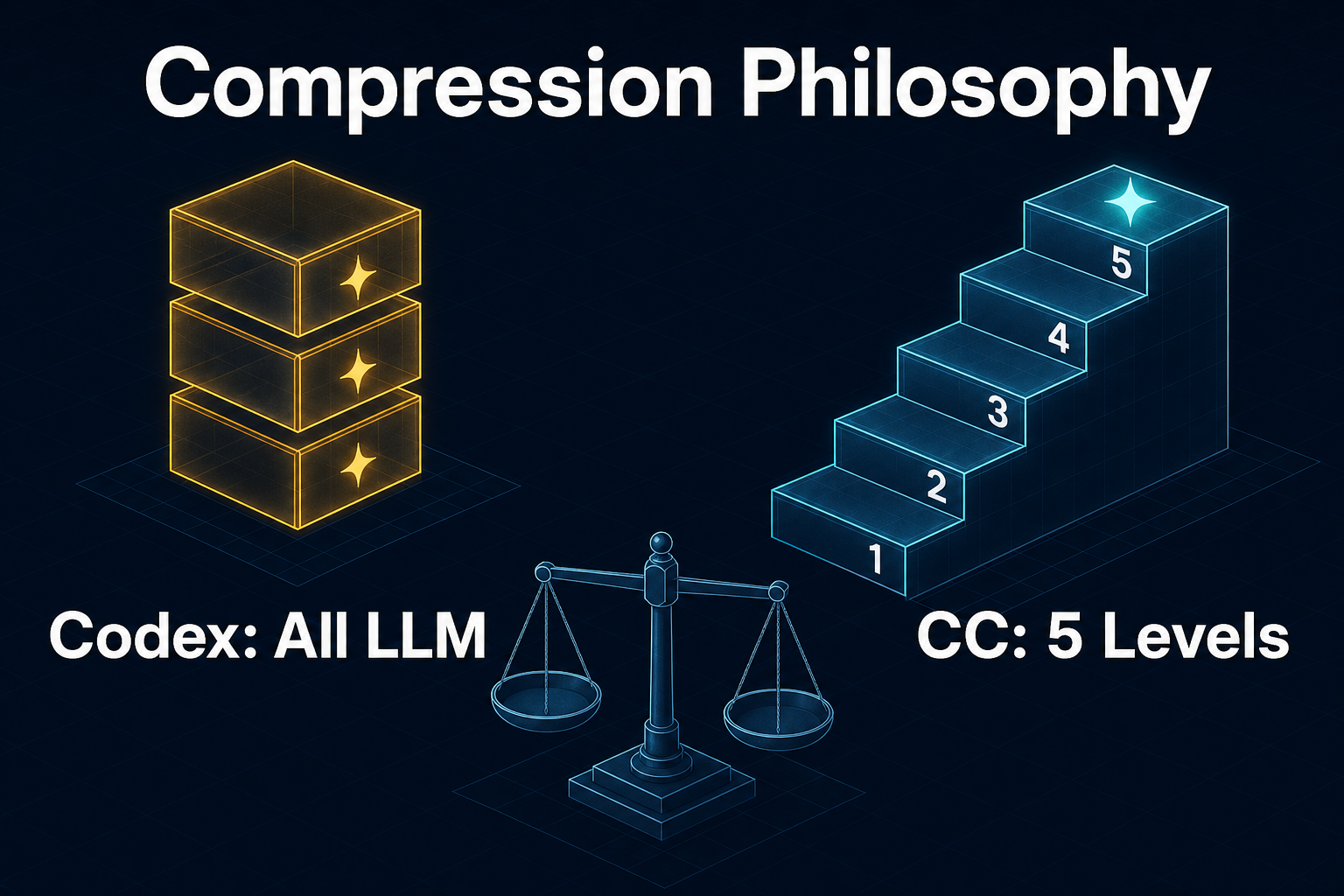
第一篇我们说过 Codex 的压缩策略和 CC 截然相反——所有压缩都涉及 LLM 调用。这一篇展开讲清楚。
Codex 的 Compact 系统有 3 个核心维度:
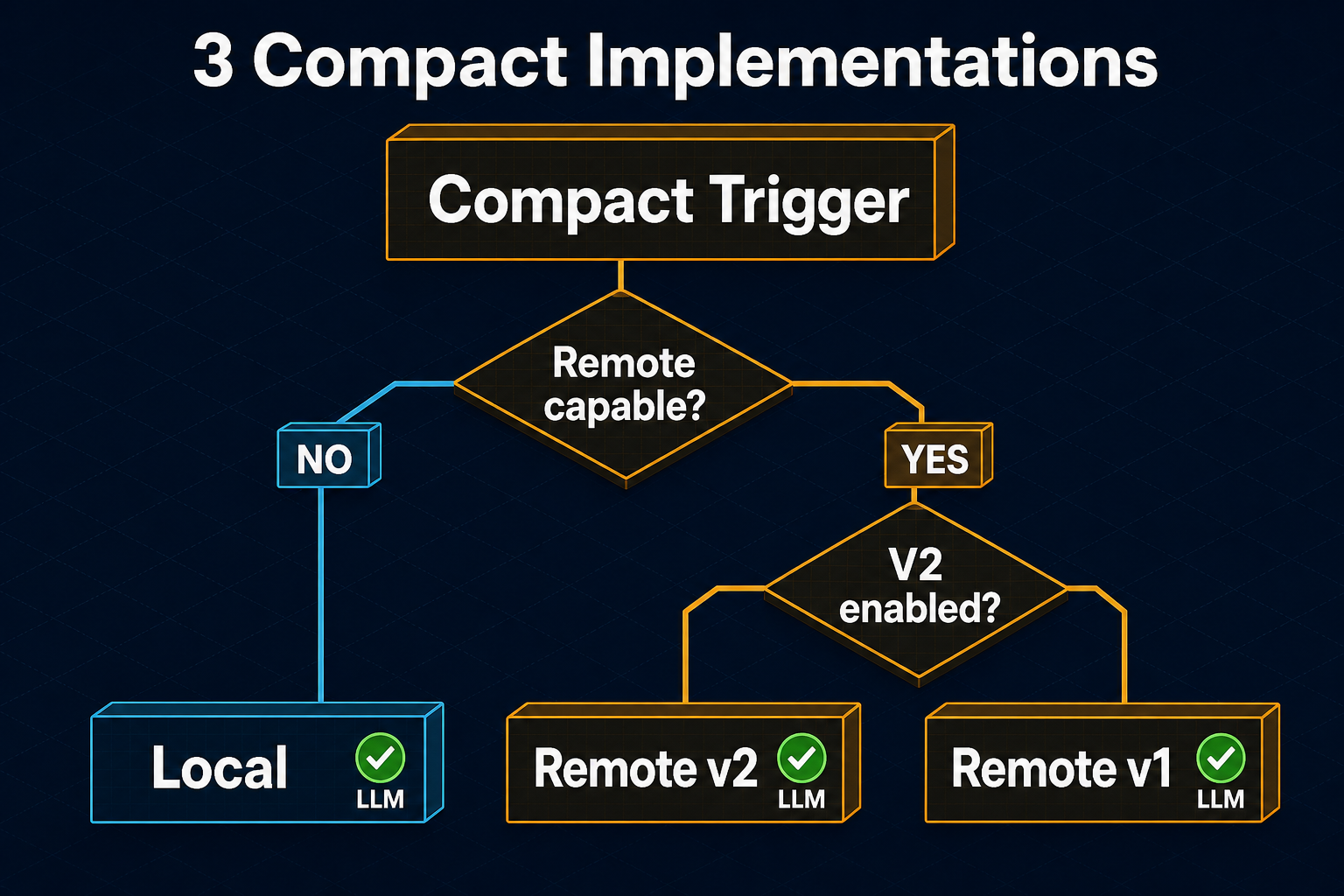
- 3 种实现:Local / Remote v1 / Remote v2,运行时根据 provider 选择
- 3 种触发时机:Pre-turn / Mid-turn / Manual
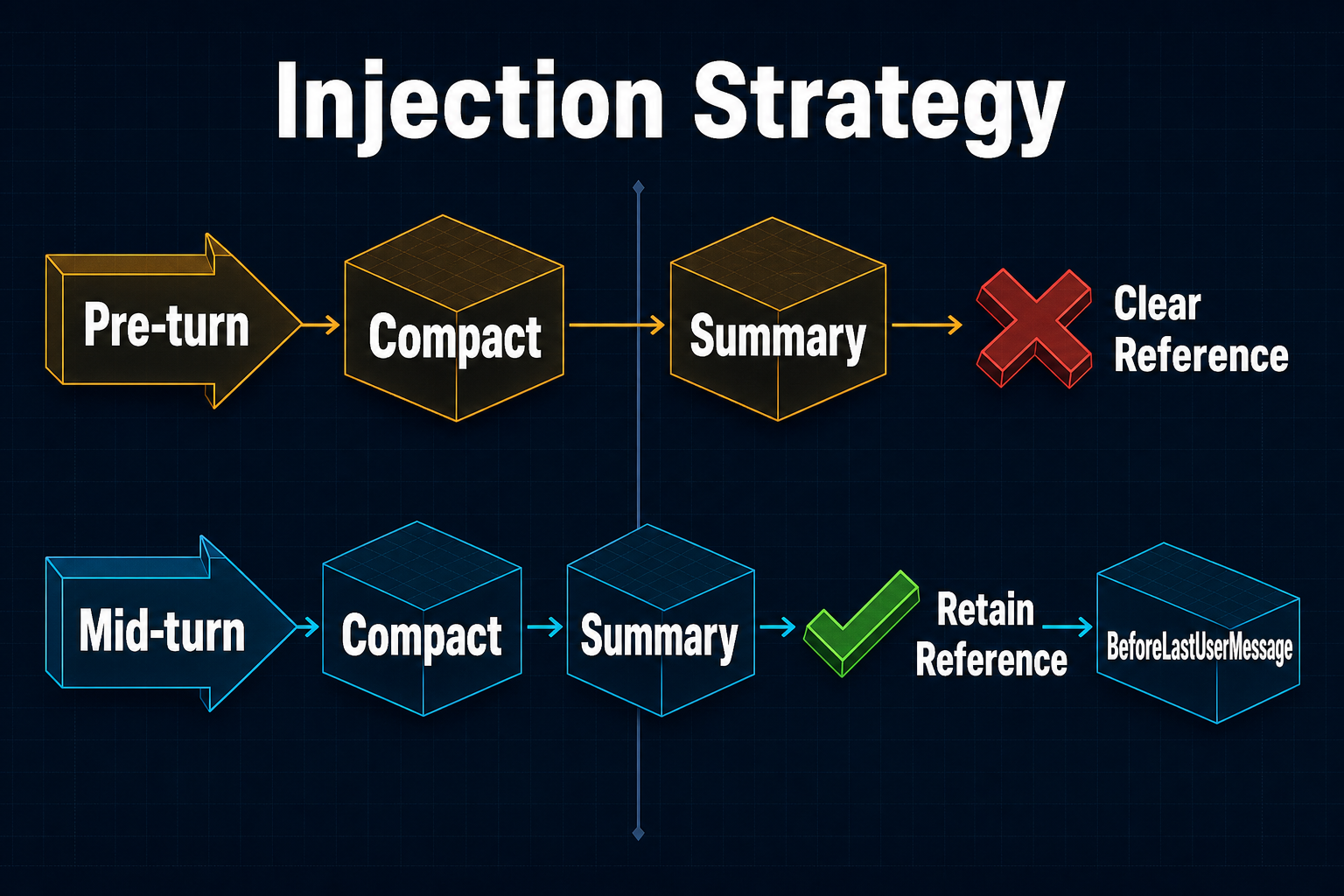
- 2 种初始上下文注入策略:BeforeLastUserMessage / DoNotInject
读完这篇你能回答:
- Codex 怎么决定用哪种压缩实现?
- 三种实现在调用链路上有什么区别?
- 为什么 Mid-turn 必须注入完整初始上下文,而 Pre-turn 不能注入?
- 和 CC 的 5 级压缩对比,谁的策略更聪明?
一、Compact 实现选择
1.1 三种实现的文件位置
codex-rs/core/src/
├── compact.rs             # Local 实现(617 行)
├── compact_remote.rs      # Remote v1 实现(485 行)
└── compact_remote_v2.rs   # Remote v2 实现(819 行)
三种实现都有同样的对外接口(每个文件都有 run_inline_auto_compact_task 和 run_remote_compact_task 两个公开函数),但内部实现差异很大。
1.2 选择逻辑:run_auto_compact
dispatcher 在 turn.rs:862:
async fn run_auto_compact(
    sess: &Arc<Session>,
    turn_context: &Arc<TurnContext>,
    client_session: &mut ModelClientSession,
    initial_context_injection: InitialContextInjection,
    reason: CompactionReason,
    phase: CompactionPhase,
) -> CodexResult<()> {
    if should_use_remote_compact_task(turn_context.provider.info()) {
        if turn_context.features.enabled(Feature::RemoteCompactionV2) {
            emit_compact_metric(&sess.services.session_telemetry, "remote_v2", false);
            run_inline_remote_auto_compact_task_v2(
                Arc::clone(sess), Arc::clone(turn_context), client_session,
                initial_context_injection, reason, phase,
            ).await?;
            return Ok(());
        }
        emit_compact_metric(&sess.services.session_telemetry, "remote", false);
        run_inline_remote_auto_compact_task(
            Arc::clone(sess), Arc::clone(turn_context),
            initial_context_injection, reason, phase,
        ).await?;
    } else {
        emit_compact_metric(&sess.services.session_telemetry, "local", false);
        run_inline_auto_compact_task(
            Arc::clone(sess), Arc::clone(turn_context),
            initial_context_injection, reason, phase,
        ).await?;
    }
    Ok(())
}
选择规则:
should_use_remote_compact_task(provider.info())—— 如果 provider 支持 remote compaction,走 remoteFeature::RemoteCompactionV2—— 如果 V2 feature 开启,走 v2;否则走 v1- fallback —— 都不满足,走 local
OpenAI 官方 provider(如 ChatGPT 订阅、OpenAI API)支持 remote compaction;Ollama、LM Studio 这类本地 provider 走 local。
1.3 三种实现的对比表
| 实现 | 文件 | 调 LLM | 调用方式 | 适用 provider |
|---|---|---|---|---|
| Local | compact.rs:70 | ✅ 是 | 同一个模型 stream | 所有(Ollama / LM Studio / OpenAI 兜底) |
| Remote v1 | compact_remote.rs:45 | ✅ 是 | Responses API compact endpoint | OpenAI 官方 |
| Remote v2 | compact_remote_v2.rs:56 | ✅ 是 | 改进版 endpoint,支持更多配置 | OpenAI 官方 + Feature flag |
所有三种都调用 LLM——这就是和 CC 最大的不同。CC 的前 4 级压缩都是纯数据结构操作(截断 tool result、Snip、Microcompact、Context Collapse),只有第 5 级才调 LLM。
二、Local 实现详解
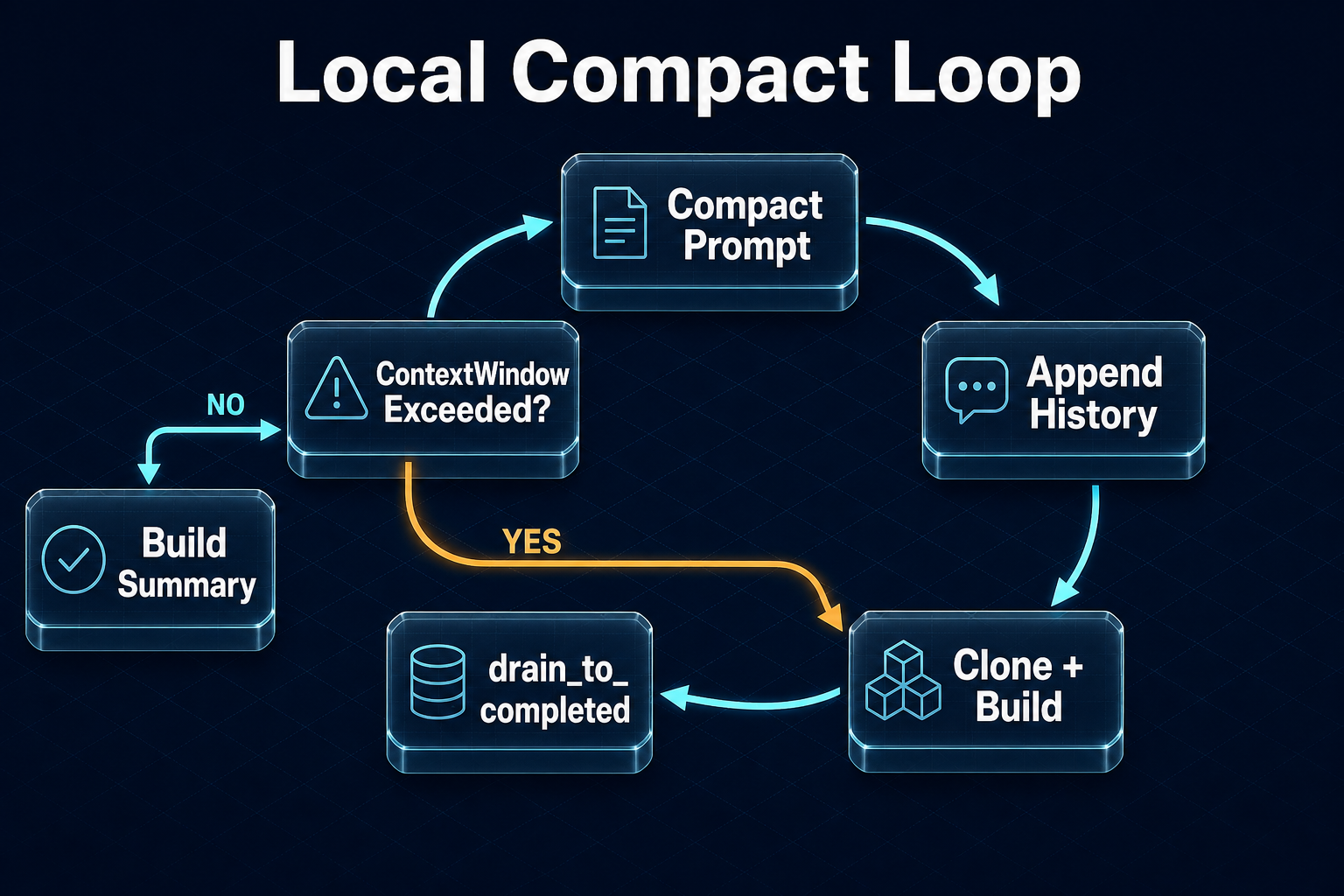
Local 是最通用的兜底实现。原理:把整个历史发给模型,要求生成摘要。
2.1 入口
compact.rs:70:
pub(crate) async fn run_inline_auto_compact_task(
    sess: Arc<Session>,
    turn_context: Arc<TurnContext>,
    initial_context_injection: InitialContextInjection,
    reason: CompactionReason,
    phase: CompactionPhase,
) -> CodexResult<()> {
    let prompt = turn_context.compact_prompt().to_string();
    let input = vec![UserInput::Text {
        text: prompt,
        text_elements: Vec::new(),
    }];
    run_compact_task_inner(
        sess, turn_context, input,
        initial_context_injection,
        CompactionTrigger::Auto, reason, phase,
    ).await?;
    Ok(())
}注意:input 不是用户的原始消息,而是 compact prompt。也就是说 Codex 把"压缩请求"作为一个新的 user message 加到 history 末尾,让模型回复一个 summary。
2.2 核心循环
run_compact_task_inner_impl 在 compact.rs:194,关键流程:
async fn run_compact_task_inner_impl(...) -> CodexResult<String> {
    let compaction_item = TurnItem::ContextCompaction(ContextCompactionItem::new());
    sess.emit_turn_item_started(&turn_context, &compaction_item).await;

    let mut history = sess.clone_history().await;
    history.record_items(&[initial_input_for_turn.into()], turn_context.truncation_policy);

    let mut retries = 0;
    let mut client_session = sess.services.model_client.new_session();

    loop {
        let turn_input = history.clone().for_prompt(&turn_context.model_info.input_modalities);
        let prompt = Prompt {
            input: turn_input,
            base_instructions: sess.get_base_instructions().await,
            personality: turn_context.personality,
            ..Default::default()
        };
        let attempt_result = drain_to_completed(
            &sess, turn_context.as_ref(), &mut client_session,
            turn_metadata_header.as_deref(), &prompt,
        ).await;

        match attempt_result {
            Ok(()) => break,
            Err(CodexErr::ContextWindowExceeded) => {
                if turn_input_len > 1 {
                    // 砍掉最旧的一条,保留 prefix cache
                    history.remove_first_item();
                    retries = 0;
                    continue;
                }
                // 砍到只剩一条还不够,报错
                return Err(e);
            }
            Err(e) => {
                if retries < max_retries {
                    retries += 1;
                    let delay = backoff(retries);
                    // 等待重试
                } else {
                    return Err(e);
                }
            }
        }
    }
    // 构建摘要 + 替换 history
}
2.3 摘要的构造
模型返回 summary 后(compact.rs:289-323):
let history_snapshot = sess.clone_history().await;
let history_items = history_snapshot.raw_items();
let summary_suffix = get_last_assistant_message_from_turn(history_items).unwrap_or_default();
let summary_text = format!("{SUMMARY_PREFIX}\n{summary_suffix}");
let user_messages = collect_user_messages(history_items);

let mut new_history = build_compacted_history(Vec::new(), &user_messages, &summary_text);
几个关键点:
SUMMARY_PREFIX是一个常量前缀,从codex_promptscrate 导入(compact.rs:48)summary_suffix= 模型返回的最后一条 assistant messageuser_messages= 历史中所有 user message(被保留下来)new_history= user messages + summary message
2.4 ContextWindowExceeded 处理
一个非常有趣的细节——如果 compact 自己也超了 context window:
Err(e @ CodexErr::ContextWindowExceeded) => {
    if turn_input_len > 1 {
        // 砍掉最旧的一条,保留 prefix cache
        history.remove_first_item();
        retries = 0;
        continue;
    }
    // ...
}
砍掉最旧的一条再试。注释是 "Trim from the beginning to preserve cache (prefix-based) and keep recent messages intact"。
注意这里的 "preserve cache" 容易被误解。实际上 history.remove_first_item() 删除的是 history.items[0]——即整个会话历史中最早的那条记录(通常是最初的 developer message / system prompt)。删掉 items[0] 会让整个 prompt 序列改变,prefix cache 会完全失效,而不是保留。
注释的真正意图是保新不保旧:既然因为 ContextWindowExceeded 必须砍一些内容,那砍掉最早的消息(而不是 compact prompt 或最近的对话)能让 compact 生成的摘要质量更高。后面的 "keep recent messages intact" 才是核心。
2.5 COMPACT_USER_MESSAGE_MAX_TOKENS 限制
compact.rs:49:
const COMPACT_USER_MESSAGE_MAX_TOKENS: usize = 20_000;这是单次 user message 的 token 上限。超过这个长度的 user message 会被 truncate。
三、Remote v1/v2 实现
3.1 Remote v1 入口
compact_remote.rs:45:
pub(crate) async fn run_inline_remote_auto_compact_task(
    sess: Arc<Session>,
    turn_context: Arc<TurnContext>,
    initial_context_injection: InitialContextInjection,
    reason: CompactionReason,
    phase: CompactionPhase,
) -> CodexResult<()> {
    run_remote_compact_task_inner(
        &sess, &turn_context,
        initial_context_injection,
        CompactionTrigger::Auto, reason, phase,
    ).await?;
    Ok(())
}
内部调用 run_remote_compact_task_inner(compact_remote.rs:89),关键的实现标记:
let compaction_metadata = CompactionTurnMetadata::new(
    trigger, reason,
    CompactionImplementation::ResponsesCompact,  // ← 标记实现类型
    phase,
);
ResponsesCompact 表示调用的是 Responses API 的专用 compact endpoint。
3.2 Remote v2
compact_remote_v2.rs:56 是改进版,主要差异:
- 支持更多元数据(如 trace context)
- 改进的失败日志(
log_remote_compaction_request_failure在:389) - 增强的 compaction output 收集(
collect_compaction_output在:406) - 通过
Feature::RemoteCompactionV2feature flag 开关
实际调用 endpoint 的实现在 run_remote_compaction_request_v2(compact_remote_v2.rs:332)。
3.3 Remote vs Local 的本质区别
| 维度 | Local | Remote |
|---|---|---|
| 调用谁 | 当前 session 的同一个模型 | OpenAI 服务端 compact 服务 |
| 是否占用模型配额 | 是(用户配额) | 是(API 服务) |
| Latency | 取决于模型速度(可能很慢) | 服务端优化(更快) |
| 摘要质量 | 取决于模型能力 | 服务端优化(更高) |
| 适用场景 | 本地模型 / 兜底 | OpenAI 官方 |
Local 实现的最大问题:用同一个模型压缩自己的对话历史——大模型压缩自己的上下文,token 成本翻倍。Remote 实现把压缩交给服务端,可能有专门的轻量模型。
四、InitialContextInjection 策略
compact.rs:61 定义了一个关键的枚举:
/// Controls whether compaction replacement history must include initial context.
///
/// Pre-turn/manual compaction variants use `DoNotInject`: they replace history with a summary and
/// clear `reference_context_item`, so the next regular turn will fully reinject initial context
/// after compaction.
///
/// Mid-turn compaction must use `BeforeLastUserMessage` because the model is trained to see the
/// compaction summary as the last item in history after mid-turn compaction; we therefore inject
/// initial context into the replacement history just above the last real user message.
#[derive(Clone, Copy, Debug, Eq, PartialEq)]
pub(crate) enum InitialContextInjection {
    BeforeLastUserMessage,
    DoNotInject,
}
4.1 两种策略的区别
Pre-turn / Manual compaction 使用 DoNotInject:
- 替换 history 为 summary
- 清空
reference_context_item - 下一次正常 turn 时,因为 reference 是 None,会触发
build_initial_context全量注入
Mid-turn compaction 使用 BeforeLastUserMessage:
- 替换 history 为 summary + 初始上下文
- 把初始上下文插入到最后一条真实 user message 之前
- 保留
reference_context_item
4.2 为什么 Mid-turn 必须注入完整初始上下文?
注释说:"the model is trained to see the compaction summary as the last item in history after mid-turn compaction"——模型被训练成看到 summary 在历史末尾。
Mid-turn 场景下,模型正在调用工具循环中,压缩完还要继续 sampling。如果不注入初始上下文,模型会丢失 developer instructions / permissions / environment 等关键信息,导致后续 sampling 行为异常。
Pre-turn 场景下,压缩完整个 turn 就结束了,下一个 turn 会重新走 record_context_updates_and_set_reference_context_item 的逻辑,自然全量注入。
4.3 注入实现
compact.rs:297-308:
if matches!(
    initial_context_injection,
    InitialContextInjection::BeforeLastUserMessage
) {
    let initial_context = sess.build_initial_context(turn_context.as_ref()).await;
    new_history =
        insert_initial_context_before_last_real_user_or_summary(new_history, initial_context);
}
let reference_context_item = match initial_context_injection {
    InitialContextInjection::DoNotInject => None,
    InitialContextInjection::BeforeLastUserMessage => Some(turn_context.to_turn_context_item()),
};
注意:调用的就是第三篇讲的 build_initial_context——Compact 是 reference_context_item 重置的两个路径之一(另一个是新会话/fork)。
五、Compact 的触发时机
回顾第一篇的 3 种触发时机,现在补全代码位置:
| 时机 | 位置 | 调用栈 |
|---|---|---|
| Pre-turn | turn.rs:150 → run_pre_sampling_compact (turn.rs:784) | 在第一次 sampling 之前检查 token budget |
| Mid-turn | turn.rs:293 → run_auto_compact (turn.rs:862) | 一轮对话中,sampling 返回后 token 超限且模型要求 follow-up |
| Manual | handlers.rs:834 → compact() → run_compact_task (compact.rs:97) | 用户主动 Op::Compact |
5.1 Pre-turn 触发条件
// turn.rs:150
if let Err(err) = run_pre_sampling_compact(&sess, &turn_context, &mut client_session).await {
    let error = err.to_codex_protocol_error();
    sess.emit_turn_error_lifecycle(turn_context.as_ref(), error.clone()).await;
    if error == CodexErrorInfo::UsageLimitExceeded {
        // ... 处理 usage limit
    }
    return None;
}
run_pre_sampling_compact 内部检查 auto_compact_token_status 返回的 token 状态。如果 token_limit_reached,调用 run_auto_compact,使用 InitialContextInjection::DoNotInject + CompactionPhase::PreTurn。
5.2 Mid-turn 触发条件
// turn.rs:293
if token_limit_reached && needs_follow_up {
    if let Err(err) = run_auto_compact(
        &sess, &turn_context, &mut client_session,
        InitialContextInjection::BeforeLastUserMessage,  // ← 关键差异
        CompactionReason::ContextLimit,
        CompactionPhase::MidTurn,
).await两个条件都满足才会 mid-turn compact:
token_limit_reached—— token 超限needs_follow_up—— 模型要求继续(如返回 tool call 还没执行完)
如果模型本轮已经返回 final message 但 token 超限,不 compact——因为下一轮 pre-turn compact 会处理。
5.3 Manual 触发
用户通过 TUI 或 API 主动触发压缩:
// handlers.rs:834
Op::Compact => {
    compact(&sess, sub.id.clone()).await;
    false
}
调用 CompactTask(tasks/compact.rs),最终走 run_compact_task(compact.rs:97),使用 CompactionTrigger::Manual + CompactionReason::UserRequested + CompactionPhase::StandaloneTurn。
六、Compact 后的 Warning
compact.rs:319 在 compact 完成后发一个 warning:
let warning = EventMsg::Warning(WarningEvent {
    message: "Heads up: Long threads and multiple compactions can cause the model to be less accurate. Start a new thread when possible to keep threads small and targeted.".to_string(),
});
sess.send_event(&turn_context, warning).await;
这是个有意思的细节——Codex 在 compact 后主动建议用户开新会话。这反映了 LLM 工程的真相:任何压缩都是有损的,多次 compact 后模型行为可能变怪。
七、Codex vs CC:压缩哲学对比
7.1 完整对比表
| 维度 | Codex | Claude Code |
|---|---|---|
| 压缩层级数 | 3 种实现 | 5 级 |
| Local 调 LLM | ✅ 是(同模型) | ❌ 前 4 级不调 |
| 远程压缩 | ✅ Responses API | ❌ 无 |
| 触发时机 | Pre-turn / Mid-turn / Manual | 每次调用前 / 超限时 |
| 触发条件 | token_limit_reached | 阈值 + 13K / 90% 利用率等 |
| 摘要生成 | 都用 LLM | 仅第 5 级 |
| prefix cache 保护 | ✅(remove_first_item) | ✅(Snip 砍中间) |
| 初始上下文注入 | 2 种策略(BeforeLastUserMessage / DoNotInject) | 隐式(每轮都注入) |
| 完成后 warning | ✅ 主动建议开新会话 | ❌ 无 |
7.2 设计哲学差异
CC 的"5 级渐进式"哲学:
- 优先用便宜的操作(数据结构变换)省空间
- 只有迫不得已才调 LLM
- 大多数会话走不到第 5 级
Codex 的"3 种 LLM 调用"哲学:
- 任何压缩都涉及 LLM(保证摘要质量)
- 选择 LLM 调用方式(本地/远程)优化成本
- 通过 InitialContextInjection 控制是否需要重注入
两种哲学各有道理:
- CC 的策略对长会话更经济——前 4 级把空间省出来,避免反复调 LLM
- Codex 的策略对短会话更简单——直接压缩,没有多级判断的复杂度
7.3 一个 Codex 的独特点:InitialContextInjection
CC 没有 InitialContextInjection 这个概念——它每次 turn 都重新构造 system prompt,所以 compact 后不需要担心初始上下文丢失。
Codex 用 diffing 优化(见第三篇),所以 compact 后必须显式决定"是否需要重注入"。BeforeLastUserMessage vs DoNotInject 就是这个决策的体现。
这是一个二阶复杂度——优化(diffing)带来了新的约束(compact 后必须重注入)。CC 用不优化换来了简单性。
八、小结
| 你学到什么 | 对应源码 |
|---|---|
| 3 种压缩实现选择 | turn.rs:862-917 (run_auto_compact) |
should_use_remote_compact_task 判断 | compact.rs:66 |
| Local 实现 | compact.rs:70 + compact.rs:194-324 |
| Remote v1 实现 | compact_remote.rs:45 |
| Remote v2 实现 | compact_remote_v2.rs:56 |
SUMMARY_PREFIX / SUMMARIZATION_PROMPT | codex_prompts crate |
COMPACT_USER_MESSAGE_MAX_TOKENS = 20_000 | compact.rs:49 |
InitialContextInjection 枚举 | compact.rs:61-64 |
| Pre-turn 触发 | turn.rs:150 → turn.rs:784 |
| Mid-turn 触发 | turn.rs:293-301 |
| Manual 触发 | handlers.rs:834 |
| Compact 后 warning | compact.rs:319 |
| ContextWindowExceeded 时砍最旧 | compact.rs:251-260 |
章节小测
本章 Quiz — 核心机制自检
1 Codex 选择哪种压缩实现时,核心判断依据是什么?
2 InitialContextInjection 枚举的两种策略(BeforeLastUserMessage vs DoNotInject)分别对应什么场景?
3 Local compact 实现中,当 compact 自身也超过 context window 时,Codex 做了什么处理?
4 Claude Code 的 5 级压缩与 Codex 的 3 种 LLM 调用压缩,两种设计哲学的根本差异是什么?