
多 Agent 编排架构
〇、引言
这是 Codex 系列中最有意思的一篇——因为我写这篇文章时发现 Claude Code 实际上也有多 Agent 系统,但和 Codex 的完全不同。
CC 有两套多 Agent 机制:
- AgentTool(同进程):通过
agent工具 spawn 子 agent,本质上是同进程内的协程切换 - Swarm(跨进程):通过
create_team/spawn_team工具创建 teammate,每个 teammate 是一个独立进程(tmux pane 或 iTerm2 split),通过 mailbox 通信
这两套各有局限,但 CC 确实有多 Agent 能力。Codex 不一样——它有从底层设计的完整的层次化多 Agent 系统,能:
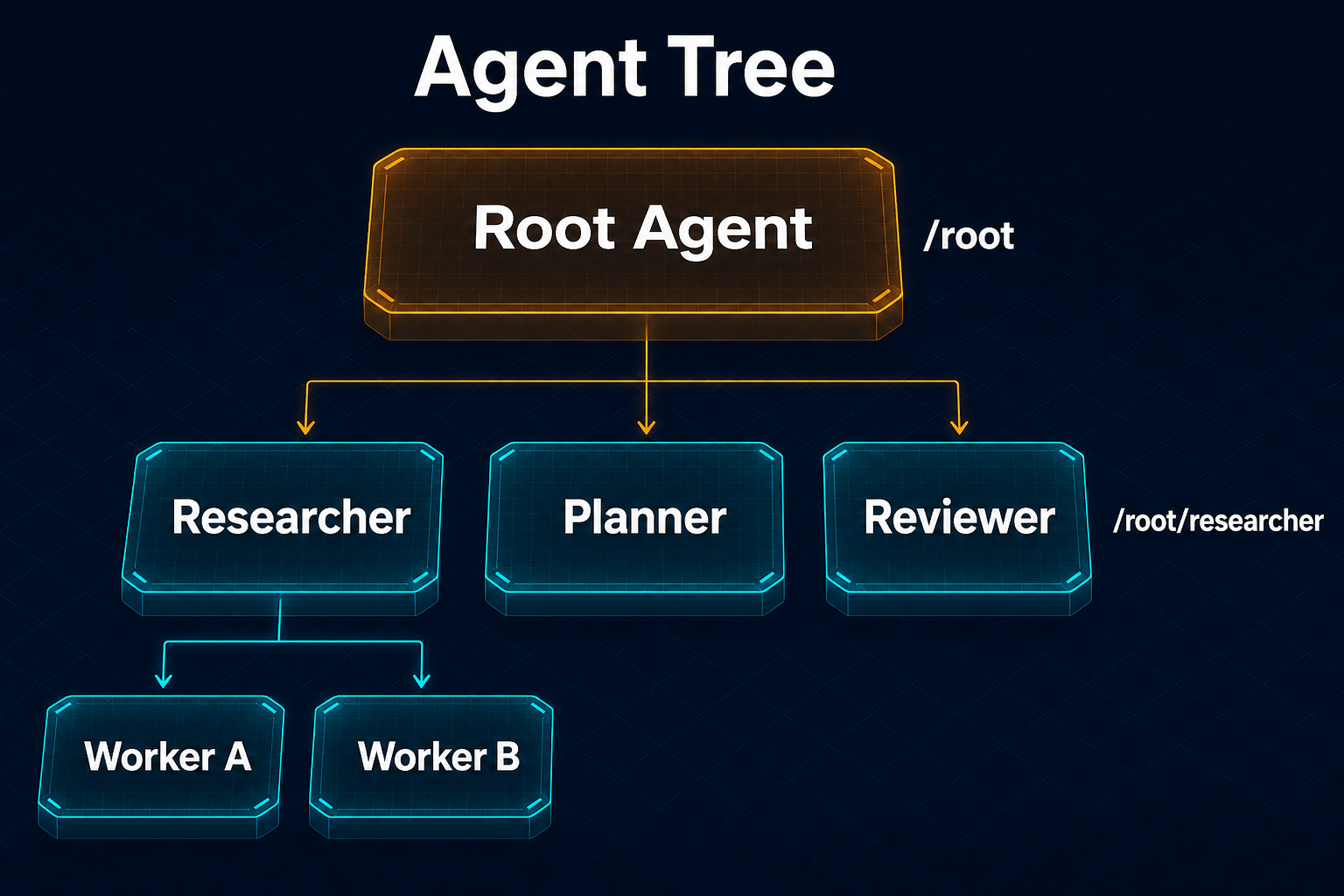
- 形成 Agent Tree(父 → 子 → 孙)
- Agent 之间通过
AgentPath互相寻址 - 父 Agent 可以 wait 子 Agent,也可以继续工作
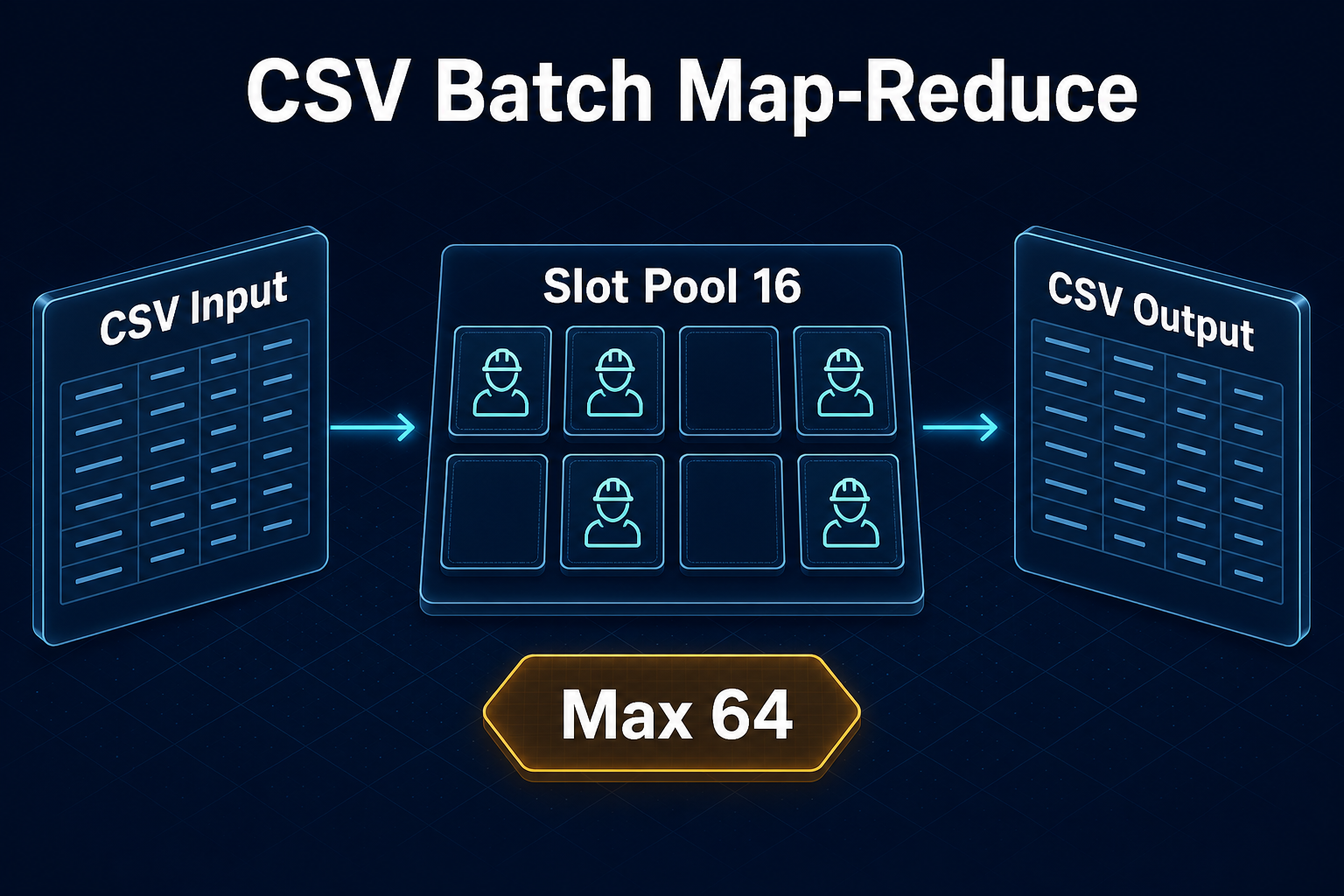
- 支持 map-reduce 风格的 CSV 批处理并行
- 完整的生命周期管理(spawn / communicate / wait / close)
这篇文章深入 Codex 的多 Agent 系统,回答:
- Agent Tree 怎么建模?父子关系怎么持久化?
- V1 和 V2 两个版本有什么区别?
- 6 种协作工具(spawn / send_message / followup_task / wait / close / list_agents)怎么工作?
- CSV 批处理并行模式怎么实现?
一、AgentControl:多 Agent 的核心入口
1.1 一个 root 一个 AgentControl
AgentControl 是多 Agent 操作的统一句柄。每个 root thread 持有一个 AgentControl 实例,所有子 Agent 共享这个实例——这样 Agent registry 的作用域就限定在单个 root thread 树内,而不是整个 ThreadManager。
定义在 agent/control.rs:151:
/// `AgentControl` is held by each session (via `SessionServices`). It provides capability to
/// spawn new agents and the inter-agent communication layer.
/// An `AgentControl` instance is intended to be created at most once per root thread/session
/// tree. That same `AgentControl` is then shared with every sub-agent spawned from that root,
/// which keeps the registry scoped to that root thread rather than the entire `ThreadManager`.
#[derive(Clone, Default)]
pub(crate) struct AgentControl {
    session_id: SessionId,
    manager: Weak<ThreadManagerState>,
    state: Arc<AgentRegistry>,
}
1.2 AgentRegistry:内存中的 Agent 树
AgentRegistry 维护所有活跃 agent 的元数据(agent/registry.rs:22):
pub(crate) struct AgentRegistry {
    active_agents: Mutex<ActiveAgents>,
    total_count: AtomicUsize,
}

struct ActiveAgents {
    agent_tree: HashMap<String, AgentMetadata>,  // 按 AgentPath 字符串索引
    used_agent_nicknames: HashSet<String>,
    nickname_reset_count: usize,
}

pub(crate) struct AgentMetadata {
    pub(crate) agent_id: Option<ThreadId>,
    pub(crate) agent_path: Option<AgentPath>,
    pub(crate) agent_nickname: Option<String>,
    pub(crate) agent_role: Option<String>,
    pub(crate) last_task_message: Option<String>,
}
注意 agent_tree 用 HashMap<String, AgentMetadata> —— key 是 AgentPath 的字符串形式(如 /root/researcher/worker),value 是该 agent 的元数据。
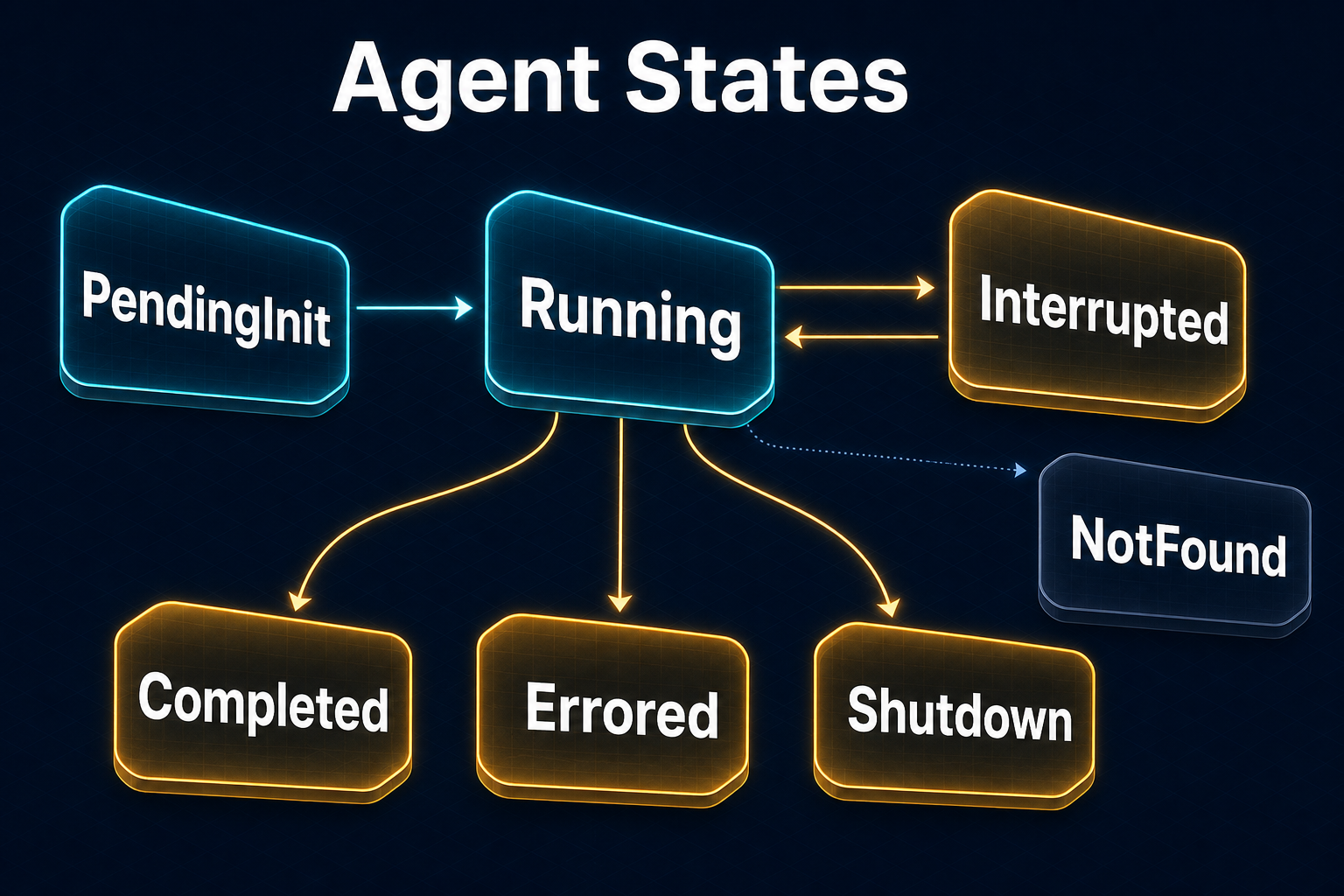
1.3 AgentStatus:7 种状态
AgentStatus 枚举(protocol.rs:1570):
pub enum AgentStatus {
    #[default]
    PendingInit,
    Running,
    Interrupted,
    Completed(Option<String>),  // 包含 final assistant message
    Errored(String),
    Shutdown,
    NotFound,
}状态从事件推导(agent/status.rs:5):
pub(crate) fn agent_status_from_event(msg: &EventMsg) -> Option<AgentStatus> {
    match msg {
        EventMsg::TurnStarted(_) => Some(AgentStatus::Running),
        EventMsg::TurnComplete(ev) => Some(AgentStatus::Completed(ev.last_agent_message.clone())),
        EventMsg::TurnAborted(ev) => match ev.reason {
            TurnAbortReason::Interrupted | TurnAbortReason::BudgetLimited => AgentStatus::Interrupted,
            _ => AgentStatus::Errored(format!("{:?}", ev.reason)),
        },
        EventMsg::Error(ev) => Some(AgentStatus::Errored(ev.message.clone())),
        EventMsg::ShutdownComplete => Some(AgentStatus::Shutdown),
        _ => None,
    }
}
is_final 判断(agent/status.rs:22):
pub(crate) fn is_final(status: &AgentStatus) -> bool {
    !matches!(status, AgentStatus::PendingInit | AgentStatus::Running | AgentStatus::Interrupted)
}
注意 Interrupted 不算 final——中断的 agent 可以恢复。
二、AgentPath:树状寻址
2.1 路径结构
AgentPath 是 V2 的寻址原语(protocol/src/agent_path.rs:9):
pub struct AgentPath(String);

impl AgentPath {
    pub const ROOT: &str = "/root";

    pub fn root() -> Self { Self(Self::ROOT.to_string()) }

    // 路径是绝对的:/root/<child>/<grandchild>
    pub fn join(&self, agent_name: &str) -> Result<Self, String> {
        validate_agent_name(agent_name)?;
        Self::from_string(format!("{self}/{agent_name}"))
    }

    // 解析相对/绝对引用: "worker" → /root/researcher/worker
    pub fn resolve(&self, reference: &str) -> Result<Self, String> {
        if reference == Self::ROOT { return Ok(Self::root()); }
        if reference.starts_with('/') { return Self::try_from(reference); }
        Self::from_string(format!("{self}/{reference}"))
    }
}
这是一个类似文件系统的路径设计:
/root是根 agent/root/researcher是 root 的子 agent "researcher"/root/researcher/worker是 researcher 的子 agent "worker"
2.2 引用解析
AgentControl::resolve_agent_reference(agent/control.rs:904)支持相对和绝对引用:
pub(crate) async fn resolve_agent_reference(
    &self,
    _current_thread_id: ThreadId,
    current_session_source: &SessionSource,
    agent_reference: &str,
) -> CodexResult<ThreadId> {
    let current_agent_path = current_session_source.get_agent_path().unwrap_or_else(AgentPath::root);
    let agent_path = current_agent_path.resolve(agent_reference)
        .map_err(CodexErr::UnsupportedOperation)?;
    if let Some(thread_id) = self.state.agent_id_for_path(&agent_path) {
        return Ok(thread_id);
    }
    Err(CodexErr::UnsupportedOperation(format!(
        "live agent path `{}` not found", agent_path.as_str()
    )))
}
这意味着 agent 可以用:
- 绝对路径:
/root/researcher(以/开头) - 相对路径:
worker(相对于当前 agent 的路径) - 特殊路径:
/root(根 agent)
这种设计让 agent 之间通信非常自然——子 agent 不知道父 agent 的全局路径,但可以用 .. 或绝对路径回到上层。
三、MultiAgentVersion:V1 vs V2
3.1 三种模式
MultiAgentVersion 枚举(protocol.rs:2760):
#[derive(Serialize, Deserialize, Clone, Copy, Debug, PartialEq, Eq, JsonSchema, TS)]
#[serde(rename_all = "snake_case")]
#[ts(rename_all = "snake_case")]
pub enum MultiAgentVersion {
    Disabled,
    V1,
    V2,
}
通过 feature flag 选择(config/mod.rs:1281):
pub(crate) fn multi_agent_version_from_features(&self) -> MultiAgentVersion {
    if self.feature_set().contains("multi_agent_v2") { MultiAgentVersion::V2 }
    else if self.feature_set().contains("multi_agent_v1") { MultiAgentVersion::V1 }
    else { MultiAgentVersion::Disabled }
}
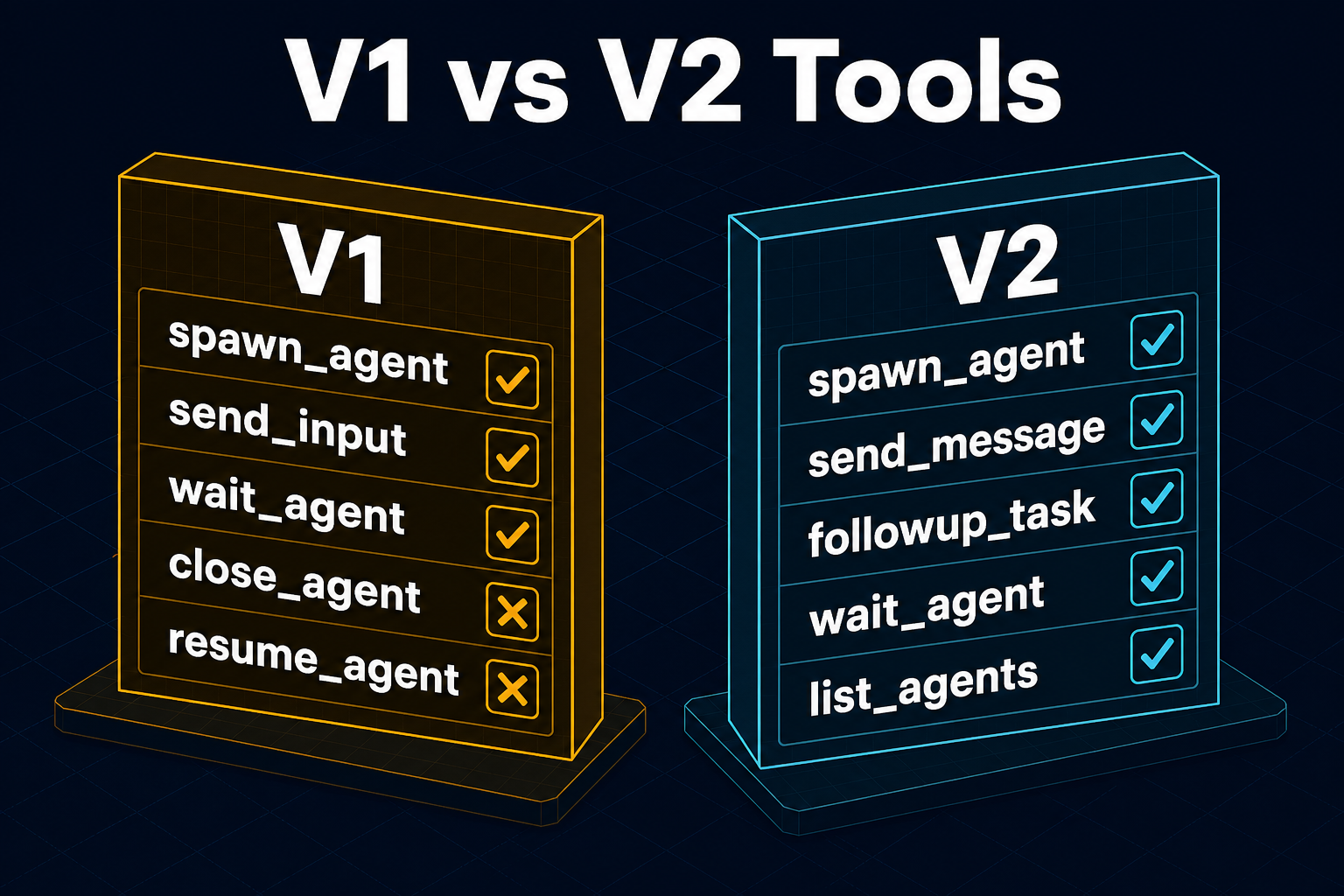
3.2 V1 vs V2 工具集对比
| 工具 | V1 | V2 |
|---|---|---|
spawn_agent | ✅ | ✅ |
send_input | ✅ | ❌ |
send_message | ❌ | ✅ |
followup_task | ❌ | ✅ |
wait_agent | ✅ | ✅ |
close_agent | ✅ | ✅ |
resume_agent | ✅ | ❌ |
list_agents | ❌ | ✅ |
V2 最大的改进:
send_messagevssend_input:V2 的 send_message 默认不触发 turn(QueueOnly),让父 agent 可以批量发消息;V2 的followup_task才触发 turnlist_agents:V2 新增,让 agent 能列出所有活跃 agent- 路径寻址:V2 通过
AgentPath寻址,V1 通过ThreadId
3.3 深度限制的差异
V1 限制递归深度(tools/handlers/multi_agents/spawn.rs:70):
let child_depth = next_thread_spawn_depth(&session_source);
let max_depth = turn.config.agent_max_depth;
if exceeds_thread_spawn_depth_limit(child_depth, max_depth) {
    return Err(FunctionCallError::RespondToModel(
        "Agent depth limit reached. Solve the task yourself.".to_string(),
    ));
}
V2 不限制深度(tools/spec_plan.rs:290):
fn collab_tools_enabled(turn_context: &TurnContext) -> bool {
    match turn_context.multi_agent_version {
        MultiAgentVersion::Disabled => false,
        MultiAgentVersion::V1 => !exceeds_thread_spawn_depth_limit(
            next_thread_spawn_depth(&turn_context.session_source),
            turn_context.config.agent_max_depth,
        ),
        MultiAgentVersion::V2 => true,   // V2: 总是启用,无深度检查
    }
}
这是个有趣的设计选择——V2 移除深度限制,依赖 agent_max_threads(并发数限制)和 agent 自己的判断来防止递归失控。
exceeds_thread_spawn_depth_limit 函数本身很简单(agent/registry.rs:63-77):
fn session_depth(session_source: &SessionSource) -> i32 {
    match session_source {
        SessionSource::SubAgent(SubAgentSource::ThreadSpawn { depth, .. }) => *depth,
        SessionSource::SubAgent(_) => 0,
        _ => 0,
    }
}

pub(crate) fn next_thread_spawn_depth(session_source: &SessionSource) -> i32 {
    session_depth(session_source).saturating_add(1)
}

pub(crate) fn exceeds_thread_spawn_depth_limit(depth: i32, max_depth: i32) -> bool {
    depth > max_depth
}
每次 spawn 子 agent,depth +1。
四、6 种 V2 工具详解
V2 工具的实现都在 tools/handlers/multi_agents_v2/ 下:
multi_agents_v2.rs          # 模块入口
├── close_agent.rs          # close_agent 工具
├── followup_task.rs        # followup_task 工具
├── list_agents.rs          # list_agents 工具
├── message_tool.rs         # 共享的消息处理逻辑
├── send_message.rs         # send_message 工具
├── spawn.rs                # spawn_agent 工具
└── wait.rs                 # wait_agent 工具
4.1 spawn_agent
spawn.rs 是最复杂的工具之一。它的核心逻辑(spawn.rs:112-150):
let spawn_source = thread_spawn_source(
    session.thread_id, &turn.session_source,
    child_depth, role_name, Some(args.task_name),
)?;

let result = Box::pin(
    session.services.agent_control.spawn_agent_with_metadata(
        config,
        match (spawn_source.get_agent_path(), initial_operation) {
            // 如果初始 op 是 text,包装为 InterAgentCommunication
            (Some(recipient), Op::UserInput { items, .. })
                if items.iter().all(|item| matches!(item, UserInput::Text { .. })) =>
            {
                Op::InterAgentCommunication {
                    communication: InterAgentCommunication::new(
                        turn.session_source.get_agent_path().unwrap_or_else(AgentPath::root),
                        recipient,
                        Vec::new(),
                        prompt.clone(),
                        /*trigger_turn*/ true,
                    ),
                }
            }
            (_, initial_operation) => initial_operation,
        },
        Some(spawn_source),
        SpawnAgentOptions { fork_parent_spawn_call_id, fork_mode, parent_thread_id, environments },
    ),
).await...
关键设计:
- task_name → agent_path:spawn 时传入的
task_name直接变成子 agent 的 path(如worker→/root/researcher/worker) - 初始消息包装:如果初始操作是纯文本,自动包装成
InterAgentCommunication,标记 trigger_turn=true - SpawnAgentOptions:包含 fork 模式、parent_thread_id、environments
4.2 send_message vs followup_task
这两个工具共用 handle_message_string_tool,差异只在 MessageDeliveryMode:
send_message 用 QueueOnly(send_message.rs)——只入队,不触发 turn:
pub(crate) struct Handler;
async fn handle(&self, invocation) -> Result<..., FunctionCallError> {
    let args: SendMessageArgs = parse_arguments(&arguments)?;
    handle_message_string_tool(invocation, MessageDeliveryMode::QueueOnly, args.target, args.message).await
}
followup_task 用 TriggerTurn(followup_task.rs)——入队并触发 turn:
pub(crate) struct Handler;
async fn handle(&self, invocation) -> Result<..., FunctionCallError> {
    let args: FollowupTaskArgs = parse_arguments(&arguments)?;
    handle_message_string_tool(invocation, MessageDeliveryMode::TriggerTurn, args.target, args.message).await
}
MessageDeliveryMode::apply 修改 trigger_turn 字段(message_tool.rs:11-31):
pub(crate) enum MessageDeliveryMode {
    QueueOnly,    // send_message
    TriggerTurn,  // followup_task
}
impl MessageDeliveryMode {
    fn apply(self, communication: InterAgentCommunication) -> InterAgentCommunication {
        match self {
            Self::QueueOnly => InterAgentCommunication { trigger_turn: false, ..communication },
            Self::TriggerTurn => InterAgentCommunication { trigger_turn: true, ..communication },
        }
    }
}
为什么这个区分重要?
send_message让父 agent 可以批量发消息给多个子 agent,再统一用followup_task唤醒它们- 这是 map-reduce 模式的核心:父 agent 把任务分发给 N 个 worker(send_message),然后让它们并行开始(followup_task),最后 wait_agent 收集结果
4.3 wait_agent
wait.rs:63 实现等待逻辑:
let mut mailbox_rx = session.input_queue.subscribe_mailbox().await;
// ... emits CollabWaitingBeginEvent ...
let deadline = Instant::now() + Duration::from_millis(timeout_ms as u64);
let timed_out = !wait_for_mailbox_change(&mut mailbox_rx, deadline).await;
let result = WaitAgentResult::from_timed_out(timed_out);
// ... emits CollabWaitingEndEvent ...注意:wait_agent 等的是当前 agent 自己 mailbox 的变化——也就是说,agent A 调用 wait_agent 时,它在等别人给 A 发消息,而不是等 A 的子 agent 完成。
如果想等子 agent 完成,需要:
- 子 agent 完成后通过 completion watcher 自动给父 agent 发
InterAgentCommunication - 父 agent 的 mailbox 收到消息
- 父 agent 的
wait_agent被唤醒
4.4 close_agent
close_agent 标记 edge 为 Closed 并递归关闭整个子树(agent/control.rs:800):
pub(crate) async fn close_agent(&self, agent_id: ThreadId) -> CodexResult<String> {
    // persists DirectionalThreadSpawnEdgeStatus::Closed
    Box::pin(self.shutdown_agent_tree(agent_id)).await
}

async fn shutdown_agent_tree(&self, agent_id: ThreadId) -> CodexResult<String> {
    let descendant_ids = self.live_thread_spawn_descendants(agent_id).await?;
    let result = self.shutdown_live_agent(agent_id).await;
    for descendant_id in descendant_ids {
        self.shutdown_live_agent(descendant_id).await?;
    }
    result
}
关闭一个 agent 时会递归关闭它所有的后代——这是树形结构的标准做法。
4.5 list_agents
V2 独有,列出当前 agent 树中所有活跃 agent。让 agent 能"看看周围有谁",决定下一步和谁通信。
五、InterAgentCommunication:消息格式
InterAgentCommunication 是 agent 之间通信的 wire format(protocol.rs:686):
pub struct InterAgentCommunication {
    pub author: AgentPath,           // 发送者
    pub recipient: AgentPath,        // 主接收者
    #[serde(default)]
    pub other_recipients: Vec<AgentPath>,  // 抄送
    pub content: String,             // 消息内容
    pub trigger_turn: bool,          // 是否触发接收者的 turn
}send_inter_agent_communication(agent/control.rs:734)是底层发送函数:
pub(crate) async fn send_inter_agent_communication(
    &self,
    agent_id: ThreadId,
    communication: InterAgentCommunication,
) -> CodexResult<String> {
    let last_task_message = communication.content.clone();
    let state = self.upgrade()?;
    let result = self.handle_thread_request_result(
        agent_id, &state,
        state.send_op(agent_id, Op::InterAgentCommunication { communication }).await,
    ).await;
    if result.is_ok() {
        self.state.update_last_task_message(agent_id, last_task_message);
    }
    result
}
底层走的是 Op::InterAgentCommunication——还记得第二篇的 submission_loop 吗?这个 Op 就是被那个 loop 接收并处理的。
六、CSV 批处理并行模式
6.1 spawn_agents_on_csv 工具
定义在 tools/handlers/agent_jobs/spawn_agents_on_csv.rs:15:
pub struct SpawnAgentsOnCsvHandler;
// 工具名: "spawn_agents_on_csv"
// 参数: csv_path, instruction, id_column, output_csv_path,
//       max_concurrency, max_workers, max_runtime_seconds
这个工具让 agent 能对 CSV 每行 spawn 一个工作 agent,实现 map-reduce 风格的批处理。
6.2 并发控制
核心循环在 agent_jobs.rs:156:
async fn run_agent_job_loop(session, turn, db, job_id, options) -> anyhow::Result<()> {
    const DEFAULT_AGENT_JOB_CONCURRENCY: usize = 16;
    const MAX_AGENT_JOB_CONCURRENCY: usize = 64;
    loop {
        // 用并发槽位填充 pending CSV 行
        if !cancel_requested && active_items.len() < options.max_concurrency {
            let slots = options.max_concurrency - active_items.len();
            let pending_items = db.list_agent_job_items(...).await?;
            for item in pending_items {
                let prompt = build_worker_prompt(&job, &item)?;
                let thread_id = session.services.agent_control
                    .spawn_agent_with_metadata(
                        options.spawn_config.clone(),
                        items.into(),
                        Some(SessionSource::SubAgent(SubAgentSource::Other(format!("agent_job:{job_id}")))),
                        SpawnAgentOptions { parent_thread_id: Some(session.thread_id), ... },
                    ).await?
                    .thread_id;
                active_items.insert(thread_id, ActiveJobItem { item_id, started_at, status_rx });
            }
        }
        // 收割完成的 worker,导出 CSV
        let finished = find_finished_threads(session.clone(), &active_items).await;
        for (thread_id, item_id) in finished {
            finalize_finished_item(session, db, job_id, item_id, thread_id).await?;
            active_items.remove(&thread_id);
        }
    }
}
设计要点:
| 配置项 | 默认值 | 上限 |
|---|---|---|
max_concurrency | 16 | 64 |
max_workers | 配置决定 | - |
max_runtime_seconds | 配置决定 | - |
并发槽位控制让大量 CSV 行可以分批 spawn——避免一次性 spawn 上千个 agent 把系统搞挂。
七、AgentGraphStore:持久化父子拓扑
7.1 trait 定义
agent 之间的父子关系不只是内存中的,还要持久化(为了 resume/fork)。AgentGraphStore trait(agent-graph-store/src/store.rs:12):
#[async_trait]
pub trait AgentGraphStore: Send + Sync {
    async fn upsert_thread_spawn_edge(
        &self, parent_thread_id: ThreadId, child_thread_id: ThreadId,
        status: ThreadSpawnEdgeStatus,
    ) -> AgentGraphStoreResult<()>;

    async fn set_thread_spawn_edge_status(
        &self, child_thread_id: ThreadId,
        status: ThreadSpawnEdgeStatus,
    ) -> AgentGraphStoreResult<()>;

    async fn list_thread_spawn_children(
        &self, parent_thread_id: ThreadId,
        status_filter: Option<ThreadSpawnEdgeStatus>,
    ) -> AgentGraphStoreResult<Vec<ThreadId>>;

    async fn list_thread_spawn_descendants(
        &self, root_thread_id: ThreadId,
        status_filter: Option<ThreadSpawnEdgeStatus>,
    ) -> AgentGraphStoreResult<Vec<ThreadId>>;
}
7.2 Edge 状态
ThreadSpawnEdgeStatus(agent-graph-store/src/types.rs:4):
pub enum ThreadSpawnEdgeStatus {
    Open,    // 子 agent 还活着或可恢复
    Closed,  // 子 agent 已被关闭
}
只有两种状态——简单。一个 agent close 后,它的 edge 变成 Closed,但关系记录保留——这让我们可以查询历史拓扑("这个 root 一共 spawn 过哪些 agent?")。
7.3 SQLite 实现
LocalAgentGraphStore(agent-graph-store/src/local.rs:13)是默认实现:
pub struct LocalAgentGraphStore {
    state_db: Arc<StateRuntime>,
}

impl LocalAgentGraphStore {
    pub fn new(state_db: Arc<StateRuntime>) -> Self { Self { state_db } }
}

#[async_trait]
impl AgentGraphStore for LocalAgentGraphStore {
    // 委托给 state_db.upsert_thread_spawn_edge / set_thread_spawn_edge_status /
    //      list_thread_spawn_children / list_thread_spawn_descendants
}
底层用 SQLite 持久化——这意味着即使进程重启,agent 拓扑关系也能恢复。
八、Completion Watcher:自动通知父 agent
8.1 V1 独有机制
V1 用一个 detached tokio 任务监控子 agent 状态,子 agent 完成时自动通知父 agent(agent/control.rs:1036):
fn maybe_start_completion_watcher(
    &self,
    child_thread_id: ThreadId,
    session_source: SessionSource,
    child_reference: String,
    child_agent_path: Option<AgentPath>,
) {
    tokio::spawn(async move {
        let status = ...;  // subscribe_status → wait for is_final
        if child_uses_multi_agent_v2 {
            // V2: 发 InterAgentCommunication 回父 agent
            let communication = InterAgentCommunication::new(
                child_agent_path, parent_agent_path, Vec::new(), message,
                /*trigger_turn*/ false,  // 不触发父 turn
            );
            control.send_inter_agent_communication(parent_thread_id, communication).await;
        } else {
            // V1: 直接注入用户消息(不触发 turn)
            parent_thread.inject_user_message_without_turn(message).await;
        }
    });
}
8.2 V2 的差异
V2 没有显式的 completion watcher——它依赖 trigger_turn 字段控制是否唤醒。send_message 默认 trigger_turn=false,所以子 agent 完成后即使发消息给父 agent,也不会打断父 agent 的工作。父 agent 主动调用 wait_agent 时才会被唤醒。
这种设计让 V2 更灵活——父 agent 可以选择"我现在就要等子 agent"还是"我让子 agent 在后台跑,我继续干活"。
九、Codex vs Claude Code:多 Agent 对比
9.1 CC 有什么?两套多 Agent 系统
CC 共有两套多 Agent 机制:
AgentTool / Task 工具(同进程):通过 agent 工具 spawn 子 agent。本质上是同进程内的协程切换,支持递归 spawn、fork、resume、agent 内存快照。
Swarm(跨进程):通过 create_team / spawn_team 工具创建 teammate。每个 teammate 是一个独立的 Node.js 进程(tmux pane、iTerm2 split 或独立窗口),通过 mailbox 通信、权限桥同步。配套有 send_message、delete_team、rename 等协作工具。
Swarm 与 AgentTool 的对比:
| 维度 | AgentTool(同进程) | Swarm(跨进程) |
|---|---|---|
| 进程隔离 | ❌ 同进程 | ✅ 独立进程 |
| 并行执行 | ❌ 阻塞主 agent | ✅ 独立运行 |
| 消息传递 | ❌ 只有 final message | ✅ send_message + mailbox |
| 递归 spawn | ✅ 支持 fork/resume | ❌ 单层(leader→teammate) |
| 状态持久化 | ✅ agent memory snapshot | ✅ teammate 文件 + reconnection |
| 通信延迟 | 低(内存) | 中(跨进程 mailbox) |
但总的来说,CC 的多 Agent 系统是后来添加上去的(swarm 相关工具命名甚至带 TeamCreateTool 等外部工具风格),不像 Codex 是从底层设计的原生能力。
9.2 Codex 多 Agent 的优势
| 能力 | Codex | CC(AgentTool) | CC(Swarm) |
|---|---|---|---|
| 真正的 Agent Tree | ✅ 递归 spawn | ⚠️ 有限递归 | ❌ 单层 |
| 独立进程/线程 | ✅ 每个 agent 独立 thread | ❌ 同进程 | ✅ 独立进程 |
| 并行执行 | ✅ N 个子 agent 同时跑 | ❌ 阻塞 | ✅ 独立运行 |
| 路径寻址 | ✅ AgentPath | ❌ 无 | ❌ 无 |
| 消息传递 | ✅ send_message + followup_task | ❌ 只有 final message | ✅ send_message + mailbox |
| 持久化拓扑 | ✅ SQLite AgentGraphStore | ⚠️ agent memory snapshot | ⚠️ teammate 文件 |
| CSV 批处理 | ✅ spawn_agents_on_csv | ❌ 无 | ❌ 无 |
| 深度限制 | V1 有限制,V2 无限制 | N/A | N/A |
| Resume/Fork | ✅ 底层支持 | ✅ fork/resume 工具 | ✅ reconnection |
9.3 设计哲学差异
CC 的 Swarm 系统反映了一个假设:多 Agent 应该通过外部进程协作(tmux / iTerm2)。每个人是一个自包含的 Claude Code 实例,通过 mailbox 通信。这套设计的好处是天然隔离,坏处是 spawn 成本高、通信延迟大。
Codex 的多 Agent 系统反映了一个不同假设:多 Agent 应该从底层集成,是框架的核心能力。通过共享的 AgentRegistry、AgentPath 寻址、InterAgentCommunication,agent 之间的协作可以非常高效。
两种哲学各有道理,落实到具体场景:
| 场景 | CC Swarm 更优 | Codex 更优 |
|---|---|---|
| 跨文件批处理(CSV 100 行) | ❌ spawn 成本高 | ✅ spawn_agents_on_csv |
| 隔离性(一个 agent 崩不影响其他) | ✅ 独立进程 | ⚠️ 同一进程 |
| 细粒度 agent 通信 | ❌ mailbox 延迟 | ✅ 进程内直接送达 |
| 轻量级子任务(快速查询) | ⚠️ spawn 一个进程太重 | ✅ spawn thread |
十、小结
| 你学到什么 | 对应源码 |
|---|---|
AgentControl 共享句柄 | agent/control.rs:151 |
AgentRegistry 内存树 | agent/registry.rs:22 |
AgentStatus 7 种状态 | protocol.rs:1570 |
AgentPath 寻址 | protocol/src/agent_path.rs:9 |
MultiAgentVersion V1/V2 | protocol.rs:2760 |
| 6 种 V2 工具 | tools/handlers/multi_agents_v2/ |
MessageDeliveryMode 区分 | message_tool.rs:11-31 |
InterAgentCommunication wire format | protocol.rs:686 |
spawn_agents_on_csv 批处理 | agent_jobs/spawn_agents_on_csv.rs:15 + agent_jobs.rs:156 |
| 并发上限 16 默认 / 64 最大 | agent_jobs.rs 中的常量 |
AgentGraphStore trait | agent-graph-store/src/store.rs:12 |
| V1 completion watcher | agent/control.rs:1036 |
| 深度限制 V1 vs V2 | tools/spec_plan.rs:290 |
章节小测
本章 Quiz — 核心机制自检
1 Codex 多 Agent 系统的 AgentPath 为什么采用类似文件系统的路径设计(如 /root/researcher/worker)?
2 V2 中 send_message 和 followup_task 的核心区别是什么?
3 为什么 V2 移除了深度限制(V1 有),改为依赖 agent_max_threads(并发数限制)?
4 Codex 的 CSV 批处理模式(spawn_agents_on_csv)中,默认并发上限和最大并发分别是多少?为什么?